
1A bed of arrows at Kurukṣetra
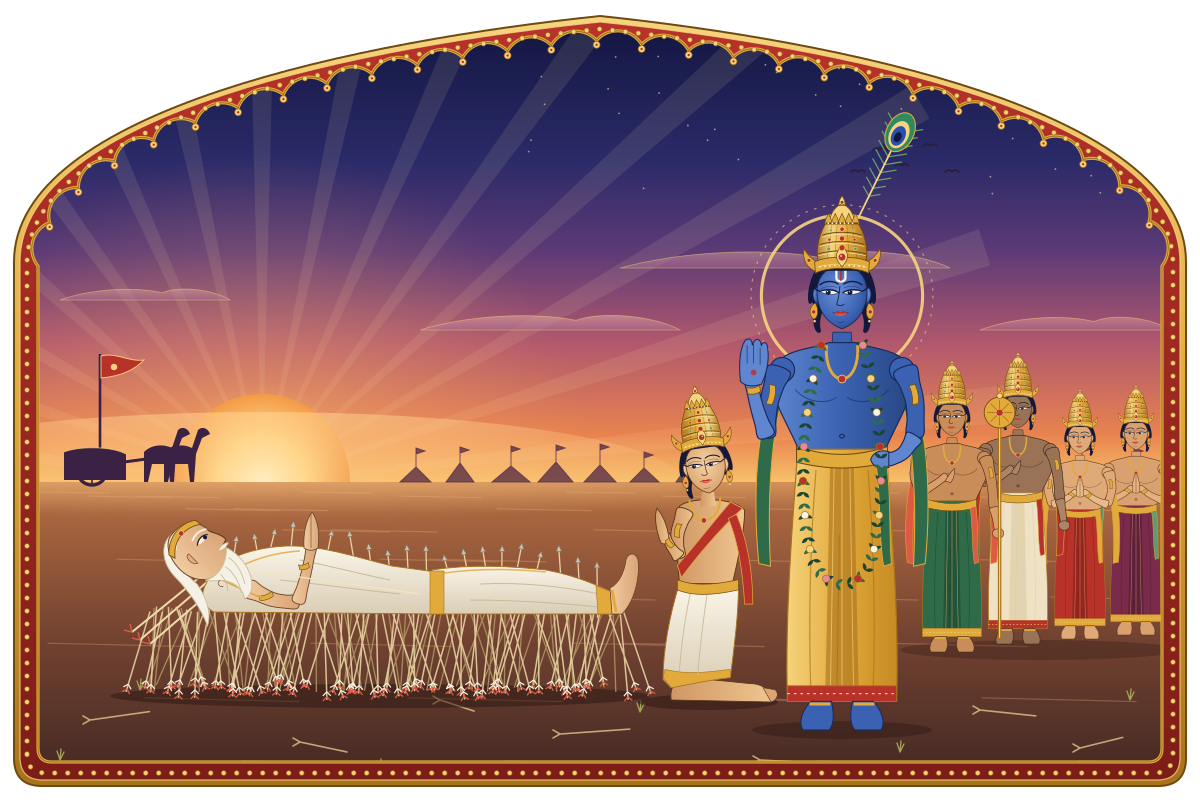
The great war is over. On the field of Kurukṣetra the grandsire of the Kuru house lies where Arjuna's arrows brought him down, on a bed made of those same arrows. This is Bhīṣma, son of King Śantanu and the river goddess Gaṅgā. The tellings say he was given the gift of dying only when he chose, and he has chosen to wait until the sun turns to its northern course. Many nights pass while he waits.
In Hastināpura Yudhiṣṭhira is king, and the victory weighs on him. Kṛṣṇa tells him that Bhīṣma will soon leave the world, and that a great knowledge of duty will leave it with him: he should go and learn while there is time. So the king goes out to the bed of arrows with Kṛṣṇa, and there Vyāsa, Nārada and a great company of sages sit around the old warrior.
Kṛṣṇa grants Bhīṣma a boon: his pain and the clouding of his mind fall away, so that he can teach. And he teaches from his bed, day after day: the duty of kings, the right course in times of distress, the way to release, and then gifts, and the duties of every kind of life. The Sahasranāmam comes late in that long teaching, in the thirteenth book of the Mahābhārata, the Anuśāsana Parva, the Book of Instruction.

2Six questions, and one answer
The chapter opens with a single line from the narrator: Yudhiṣṭhira, having heard the dharmas in full and every teaching that purifies, speaks once more to the son of Śantanu. What he asks now is not about ruling. It is the question beneath all the others.
युधिष्ठिर उवाचyudhiṣṭhira uvāca Yudhiṣṭhira
The Frame 2 →किमेकं दैवतं लोके किं वाऽप्येकं परायणम्।kimēkaṃ daivataṃ lōkē kiṃ vā’pyēkaṃ parāyaṇam|
स्तुवन्तः कं कमर्चन्तः प्राप्नुयुर्मानवाः शुभम्॥ २ ॥stuvantaḥ kaṃ kamarcantaḥ prāpnuyurmānavāḥ śubham|| 2 ||
He asks it in six parts. Who is the one God in the world? What is the one final refuge? Praising whom, and worshipping whom, do people reach the good? Of all dharmas, which do you hold the highest? And by reciting what is a living being freed from the bond of birth and the round of becoming?
Bhīṣma's answer begins with a person, not a doctrine. Let a person, ever ready, praise with a thousand names the Lord of the world, the God of gods, the Endless, the highest Person; let him worship Him always with devotion, meditate on Him, praise Him and bow to Him. Whoever praises Viṣṇu every day, the One without beginning or end, the great Lord of all the worlds, passes beyond all sorrow.
For the highest dharma his reply is one line: this, to me, is the greatest of all dharmas, that a person should always worship the lotus-eyed One with hymns, in devotion. For the one refuge he names Him outright: the highest splendour, the highest austerity, the highest Brahman, the highest refuge; the purest of all that purifies, the blessing in every blessing, the God of gods, the undying father of beings, from whom all beings come forth when an age begins and into whom they return when it ends.
Then he makes his promise: hear from me, O king, the thousand names of Viṣṇu, Lord of the world, that take away sin and fear. They are gauṇāni, names that come from His qualities, renowned and sung by the sages, and he will tell them for the sake of well-being. That one word, gauṇāni, sets the key for all that follows.
3Who speaks, and who is listening
The hymn is a voice within a voice. The whole Mahābhārata is told by the sage Vaiśampāyana, a pupil of Vyāsa, to King Janamejaya, Arjuna's great-grandson, at the king's serpent sacrifice, in the pauses between the rites; Vyāsa himself bade him tell it. That is why the chapter opens with Vaiśampāyana's line, and why the listening king is never named in it.
Inside that telling, Bhīṣma speaks to Yudhiṣṭhira, and the whole hymn is in his voice: the answer, all thousand names, and the verses on their fruits that follow. Yudhiṣṭhira speaks only his questions; then, as we do, he listens.
Kṛṣṇa is there as well. The epic brings Him to the bed of arrows through the days of the teaching, and the tradition tells that He was present when the names were spoken, so that the One being praised was among those who heard His praise. The nyāsa, for its part, names the deity of the hymn as the Lord, the son of Dēvakī.
Behind every voice stands Vyāsa. The epic is his; the nyāsa names him as the seer of the thousand names, and the last verses of the chapter call the hymn the praise of Viṣṇu as Vyāsa told it. The opening invocations honour him as the great-grandson of Vasiṣṭha, the grandson of Śakti, the son of Parāśara and the father of Śuka, and then bow to him as Viṣṇu in the form of Vyāsa, and Vyāsa in the form of Viṣṇu.
The People page gathers them all on one map: the tellers and the listeners, the line of Vyāsa, the houses of Kuru and of Yadu, the voices of the closing verses, the forms of the Lord that the names recall, and the teachers who opened the names for later readers. Each one there is shown with the others they are bound to.
4The hymn as it is recited
In the epic the chapter is simple in outline: thirteen verses of question and answer, a hundred and seven ślokas of names, and twenty-two verses on what the names bring, a hundred and forty-two verses in all. Around it the tradition of recitation has gathered more, and this edition prints the whole, in the order a reciter follows from the first word to the last.
It begins with invocations. The reciter meditates on Viṣṇu, white-robed, moon-coloured, four-armed, His face serene, so that every obstacle may be stilled; takes refuge in Viṣvaksēna, whose hundreds of attendants strike down every hindrance; bows to Vyāsa; and bows to the One at whose mere remembrance a being is freed from the bond of birth. Then come Vaiśampāyana's line, Yudhiṣṭhira's questions and Bhīṣma's answer.
Next is the nyāsa, which sets the hymn out as a great mantra and names its parts before a word of it is said: its seer is Vyāsa, its metre anuṣṭubh, its deity Śrī Mahāviṣṇu, the Supreme Self, Śrīman Nārāyaṇa. It goes on to name the hymn's seed, its power, the pin that fastens it, its weapon, its eye and its armour, and each of these is a phrase taken from the ślokas of names. The seed is amṛtāṃśūdbhavō bhānuḥ, the Source of the moon, the Radiant; the pin is śaṅkhabhṛnnandakī cakrī, the Bearer of the conch, the sword and the discus, from the very last śloka; the armour is trisāmā sāmagaḥ sāma, three names that find Him in the chanting of the Sāman. The hymn is sealed and guarded by its own words.
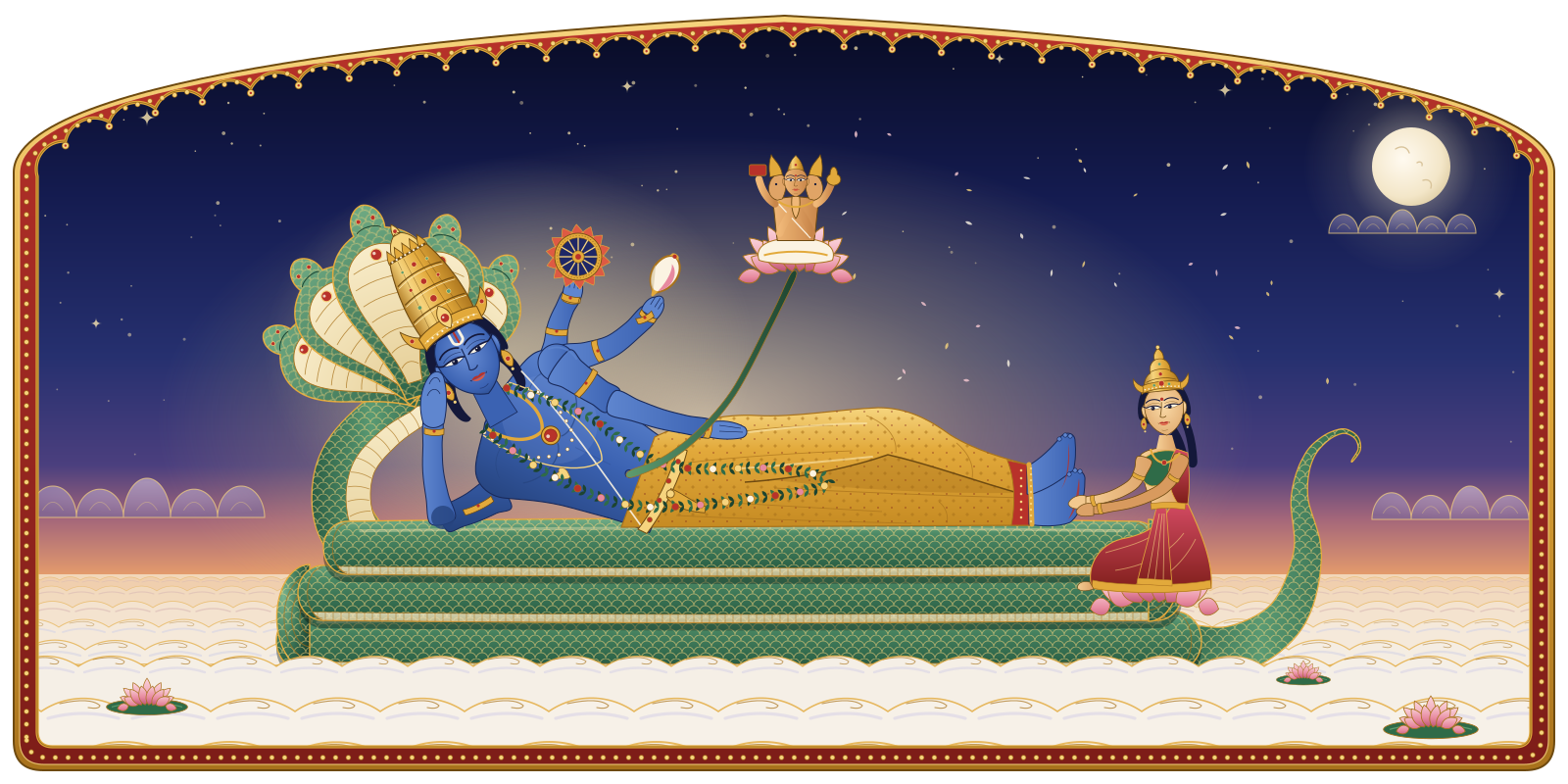
Then the dhyāna, the meditation, gives the mind something to behold before the names begin. It sees the Lord on a shore of the Milk Ocean whose sands glitter with gems, seated on a seat of strung pearls, white clouds above Him raining nectar; then the whole universe as His body, the earth His feet, the sky His navel, the sun and moon His eyes, the quarters His ears; then the peaceful One who lies on the serpent, the lotus at His navel, the beloved of Lakṣmī; and at last Kṛṣṇa on a golden throne in the shade of the pārijāta tree, cloud-dark and four-armed, with Rukmiṇī and Satyabhāmā beside Him.
After the hundred and seven ślokas the reciter asks for the protection of the Lord who wears the forest garland and bears the mace, the bow, the conch, the discus and the sword. Then come the twenty-two verses of fruits that close the chapter, and after them the verses that the tradition has set around its end.

5A thousand names in 107 ślokas
The names begin with a single word that holds everything, viśvaṃ, the All, and they run for a hundred and seven ślokas to the Lord who bears every kind of weapon, sarvapraharaṇāyudhaḥ. Between those two lies the whole of what He is.
Śloka 1 →ओं विश्वं विष्णुर्वषट्कारो भूतभव्यभवत्प्रभुः।ōṃ viśvaṃ viṣṇurvaṣaṭkārō bhūtabhavyabhavatprabhuḥ|
भूतकृद् भूतभृद्भावो भूतात्मा भूतभावनः॥ १ ॥bhūtakṛd bhūtabhṛdbhāvō bhūtātmā bhūtabhāvanaḥ|| 1 ||
A śloka of names is not a list with commas. The names run into one another by sandhi, the joining of sounds, so that two names can read as one word and one long name can look like several: in the first line, viṣṇurvaṣaṭkārō is Viṣṇu, He who pervades, and Vaṣaṭkāra, He for whom the offering is called. To count the thousand is already to read them, deciding where one name ends and the next begins. In the division this site follows, a śloka carries as few as seven names and as many as thirteen.
The great commentators do not always divide alike. Where Ādi Śaṅkara reads sthavirō dhruvaḥ as a single name, Parāśara Bhaṭṭar hears two, the Ancient and the Firm; yet both come to a thousand, and both reach it at the same last name.
Some names come back. The name Viṣṇu itself comes three times, the Giver of Life four times, and in the seventy-fourth śloka the Giver of Wealth closes one line and opens the next. The tradition hears no repetition in this: each return is read afresh, by the place where it stands. In nārasiṃhavapuḥ śrīmān the Glorious stands just after the form of the Man-Lion, and Bhaṭṭar takes its glory as the beauty of that very form. In the last śloka cakrī, the Bearer of the discus, is followed soon after by the One with the wheel in His hand, and the tradition reads the second as the discus held ready for use.
One number needs a word, said once and plainly. The Āśramam's nāmāvaḻi, the list in which each name is offered on its own, as in ōṃ viśvāya namaḥ, salutation to the All, runs to 1,003 offerings, because it divides a few names more finely than the usual reckoning: the Eternal and the Steadfast, one name in both great commentaries, are offered there as two. The names are a thousand. The numbers this site shows are the Āśramam's, so that they match the list as it is recited from this edition.
6Every name a quality
Bhīṣma calls the names gauṇāni, names that come from qualities, and the word changes how they are heard. A name in this hymn is not a label fixed on the Lord from outside. Each one says something true of Him: what He is, what He does, how He holds and helps all that He has made.
The Frame 13 →यानि नामानि गौणानि विख्यातानि महात्मनः।yāni nāmāni gauṇāni vikhyātāni mahātmanaḥ|
ऋषिभिः परिगीतानि तानि वक्ष्यामि भूतये॥ १३ ॥ṛṣibhiḥ parigītāni tāni vakṣyāmi bhūtayē|| 13 ||
Of the many commentaries on the hymn, two are read above the rest. The first is attributed by tradition to Ādi Śaṅkara, the great teacher of Advaita, whom historians place in the eighth century, and it is traditionally counted among his earliest works. It opens each name by its roots and by scripture, and its gaze rests on the Lord's supremacy: the One who rules all things and stands beyond them.
The second is the Bhagavad Guṇa Darpaṇam, the Mirror of the Lord's Qualities, by Parāśara Bhaṭṭar of Śrīraṅgam, a teacher of the twelfth century by the tradition's reckoning and the son of Kūrattāḻvāṉ, Rāmānuja's chief disciple. The tradition tells that Rāmānuja, keeping a last wish of Yāmunācārya to honour the sages Parāśara and Vyāsa, gave their names to Kūrattāḻvāṉ's twin sons, and that the commentary on the thousand names was asked of the elder.
Bhaṭṭar takes Bhīṣma's word at its full weight. Every name, for him, is a guṇa of the Lord, and the tradition that reads with him hears in each a quality of Śrīman Nārāyaṇa, with Śrī never apart from Him. So he explains a name by its root and by scripture, then stays with what that quality means to the one who comes to Him; where Śaṅkara's commentary dwells on the Lord's greatness, his dwells on how near that greatness comes, how gentle it is and how easily reached. And he reads the names as a sequence rather than a heap. They fall into groups, each tied to one of the Lord's forms: the Supreme, the forms of the vyūha, the descents, the image in the temple, the Lord within the heart. The first run of names, he says, is the answer to Yudhiṣṭhira's first two questions.
Names that a reader may know as another god's, such as Śiva, the Auspicious, or Rudra, are here names of the one Lord being praised, and both commentaries read them so. Read this way, the thousand names are less a list than a portrait: a mirror held up to His qualities, as Bhaṭṭar's title says.

7What the hymn promises
The twenty-two verses that close the chapter are called the phalaśruti, the hearing of the fruits. They do promise fruits, plainly and generously. But several of them turn from what the reciter gains to who the Lord is, and say it in lines as wide as the sky.
The Fruits of Reciting 14 →द्यौः सचन्द्रार्कनक्षत्रा खं दिशो भूर्महोदधिः।dyauḥ sacandrārkanakṣatrā khaṃ diśō bhūrmahōdadhiḥ|
वासुदेवस्य वीर्येण विधृतानि महात्मनः॥ १४ ॥vāsudēvasya vīryēṇa vidhṛtāni mahātmanaḥ|| 14 ||
The promises are given in the hymn's own terms. Whoever hears these names or recites them every day meets nothing inauspicious, in this world or the next. A gift is named for each of the four classes: the brahmin comes to know the Vēdānta, the kṣatriya wins victory, the vaiśya gains wealth, the śūdra finds happiness. Whoever seeks dharma gains dharma, and whoever seeks wealth, desire or children gains them. The sick are freed from sickness, the bound from their bonds, the frightened from fear and the afflicted from affliction, and whoever praises the highest Person in devotion each day with the thousand names soon crosses every hard place.
Some gifts belong to this life: wide renown, a high place among one's kin, a prosperity that does not waver and the highest good; health, vigour and radiance, and no fear anywhere. The deepest are inward. One who takes refuge in Vāsudēva and holds Him as the final goal is cleansed of every sin and reaches the eternal Brahman; among His devotees nothing inauspicious is found, and the fear of birth, death, old age and sickness does not even arise. In those who love the highest Person there is no anger, no envy, no greed and no evil thought.
Then the verses widen into a creed. The whole world, moving and unmoving, with gods and asuras, gandharvas, yakṣas, serpents and rākṣasas, lies in the power of Kṛṣṇa. The senses, mind and intellect, strength and steadiness, the field of the body and the self that knows it, are said to have Vāsudēva as their very self. Right conduct is set first in every teaching, dharma is born of right conduct, and the Lord of dharma is Acyuta. Sages, ancestors and gods, the great elements, all that moves and all that is still, come from Nārāyaṇa; yoga and knowledge, the Sāṅkhya, the arts and crafts, the Vēdas, the śāstras and all learning come from Janārdana. And at the last: the one Viṣṇu, the great Being, has become the many beings, pervades the three worlds as their inner Self, and enjoys all, undecaying.
The chapter ends as it began, with a person. Whoever wishes for the good, and for happiness, should recite this hymn of the Lord Viṣṇu that Vyāsa told; and those who worship the lotus-eyed Lord of all, the unborn, from whom the world comes forth and into whom it returns, never meet defeat. In recitation those last words are said twice over: na tē yānti parābhavam.
8The voices that close the recitation
With the fruits, the chapter of the epic is complete. The recitation goes a little further, through verses that the tradition has gathered around the chapter, in many voices. Arjuna prays first: O lotus-eyed One, lotus-navelled, best of gods, Janārdana, be the protector of the devoted who love You. And the Lord answers: whoever longs to praise Me with the thousand names, O Pāṇḍava, has praised Me with a single verse; of this there is no doubt.
Vyāsa plays on the sound of the Lord's own name, Vāsudēva, the One in whom all dwell: the three worlds are pervaded by Him, and He is the dwelling of all beings; salutation to Him. Pārvatī asks Īśvara by what easy means the learned recite the thousand names every day, and he answers with the verse of the name of Rāma, śrīrāma rāma rāmēti: the name of Rāma is equal to the thousand names.
Brahmā bows to the endless Person of a thousand forms, with a thousand feet, eyes, heads, thighs and arms, the One of a thousand names, eternal, who bears a thousand crores of ages. Sañjaya speaks the last verse of the Bhagavad Gītā: where Kṛṣṇa the Lord of yoga is, and where Arjuna the archer is, there are fortune and victory, well-being and sure right conduct; so he holds. The Lord speaks two verses of His own from the Gītā: He Himself carries the welfare of those who think of Him alone and worship Him, ever joined to Him; and He comes into being, age after age, to shelter the good, to end the wicked and to set dharma firm.
Two verses end it. The distressed and the despairing, the weak and the afraid, those caught in dreadful sickness, who only call out the word Nārāyaṇa, are freed from their sorrow and are happy. And the last is the familiar verse of offering: whatever I do, with body, speech or mind, with the senses, the intellect or the self, or by the bent of my nature, all of it I give over to the One beyond all, saying, to Nārāyaṇa. The hymn ends by giving everything back.

9Reciting the thousand names
The Sahasranāmam is recited daily in many homes, and its own verses describe the one who recites: devoted, rising each day, pure, with a mind gone out to Him. The printed order is the order of a full recitation: the invocations, Bhīṣma's frame, the nyāsa and the dhyāna, the hundred and seven ślokas, the fruits, and the closing verses.
The nyāsa and the dhyāna are the threshold. The nyāsa names the seer, the metre and the deity, and declares the purpose of what follows: the recitation of the thousand names, for the Lord's delight. The dhyāna places Him before the mind's eye, so that when the names begin they are spoken to Someone already seen.
Teachers have said that the names bless even before their meaning is known, as a chest of treasure is kept safe until its key is found. Bhaṭṭar gives the other half: to say the names without their meaning is good, but their meaning brings delight to the mind and purity to the heart. This site is made for both, the saying and the understanding.
Its Recite page shows the hymn one verse at a time, large and calm, in the script you choose, from the first invocation to the verse of offering. A tap, a swipe, the space bar or the arrow keys move you on, or the verses can advance by themselves at a slow, steady or brisk pace, timed to their syllables. The meaning can rest beneath each verse or be put away, the screen stays awake while you recite where the device allows it, and the page remembers where you stopped.
It can also offer the names one by one, each in the form it takes in worship, with ōṃ and namaḥ, and a short gloss beneath. Every verse on the reading pages carries a small mark that begins the recitation from that verse.
10How to read this site
The text is the edition of the Śrīmad Āṇḍavan Āśramam, in the Śrīvaiṣṇava tradition of Rāmānuja and Vēdānta Dēśika. It is shown in six scripts, Devanāgarī, Tamil, Roman, Telugu, Kannada and Malayalam; choose a script once and every page follows it.
The Read pages go verse by verse, from the opening invocations to the last of the closing verses, with nine ślokas of names to a page. Each verse is followed by its words, with the joins undone and the sense of each given, then the meaning of the whole, and often a short reflection on what the verse is doing. In the ślokas of names every name is set out with its number, a brief gloss and a sentence on what it shows of Him.
The meanings are written for this site, from the words themselves and the tradition's understanding of them, and where the Śrīvaiṣṇava reading of a name is known, it is Bhaṭṭar's. The Names pages hold all the thousand in order, a hundred to a page, with a search that finds a name in any spelling. The People page draws the map of everyone who speaks in the hymn or is named in it, and the About page gives the edition, the sources and the thanks.
Begin wherever you like: with Bhīṣma on his bed of arrows, with a single name, or with the first verse of the recitation. Bhīṣma's own counsel was simple: worship Him always, with devotion; meditate on Him, praise Him, bow to Him.